Brother, How Long? A Novel By David O'Reilly
BROTHER, HOW LONG?
Set in rural Florida in 1920, my 95,000-word novel Brother How Long? shines a light on the appalling but little-known practice of debt slavery in the American South.
Seventeen year old Althea Walker flees home to become a schoolteacher only to be assigned to a remote turpentine camp where dozens of Black men are held captive in forced labor.
Her first instinct is to flee, but she stays on, fights for justice, and discovers she's far stronger than she ever knew
Atmosphere Press will publish Brother, How Long? in August. The first chapter appears below.
About the Author
I'm David O'Reilly, a former feature writer, religion reporter, editor and foreign correspondent for the Philadelphia Inquirer.
Over the course of my newspaper career I interviewed the Dalai Lama, Pope Francis, President Carter, James Baldwin, physicist Freeman Dyson, philosopher Charles Taylor, folk singer Pete Seeger, and countless plain folks. My colleagues and I reported aggressively -- and transformatively -- on clergy sex abuse. My travels took me to Japan, Brazil, Kenya, Cuba, the Vatican, Paris, Ireland. and across the U.S. I love journalism and I've won many awards, but when fiction called I couldn't say no. This is my first novel.
2024 Writer of the Year: International Regional Magazine Association
Reporter of the Year: Religion Newswriters Association (twice)
Best Newspaper Writing in America (anthology)
Building a Book
My publisher is Atmosphere Press in Austin, Tex. They get 1,500 submissions a month and choose 30. The first thing my editor asked when we met was "Did you say this is your first novel?" I said it was. He replied: "It sure doesn't read like a first novel," and I kind of slumped, supposing he meant it just didn't work as fiction. But then he said no, no: that it reads extraordinarily well and that he'd found it very moving. Whew!
Now we move towards copy editing, proofreading, layout and typesetting.
I'm hoping readers who enjoyed James by Percival Everett -- a brilliant riff on Mark Twain's Adventures of Huckleberry Finn, told in the voice of Jim -- will be drawn to Brother, How Long?, since both narratives unfold against a backdrop of slavery.
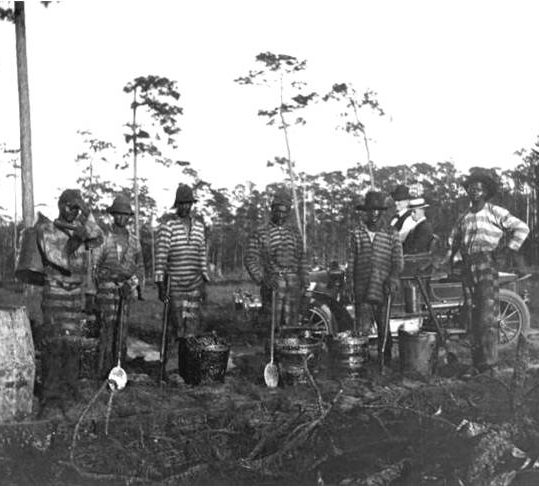
DEBT SLAVERY, OR DEBT PEONAGE, was a legal ruse Southern states used a century ago to trap men in brutal labor against their will, often for years.
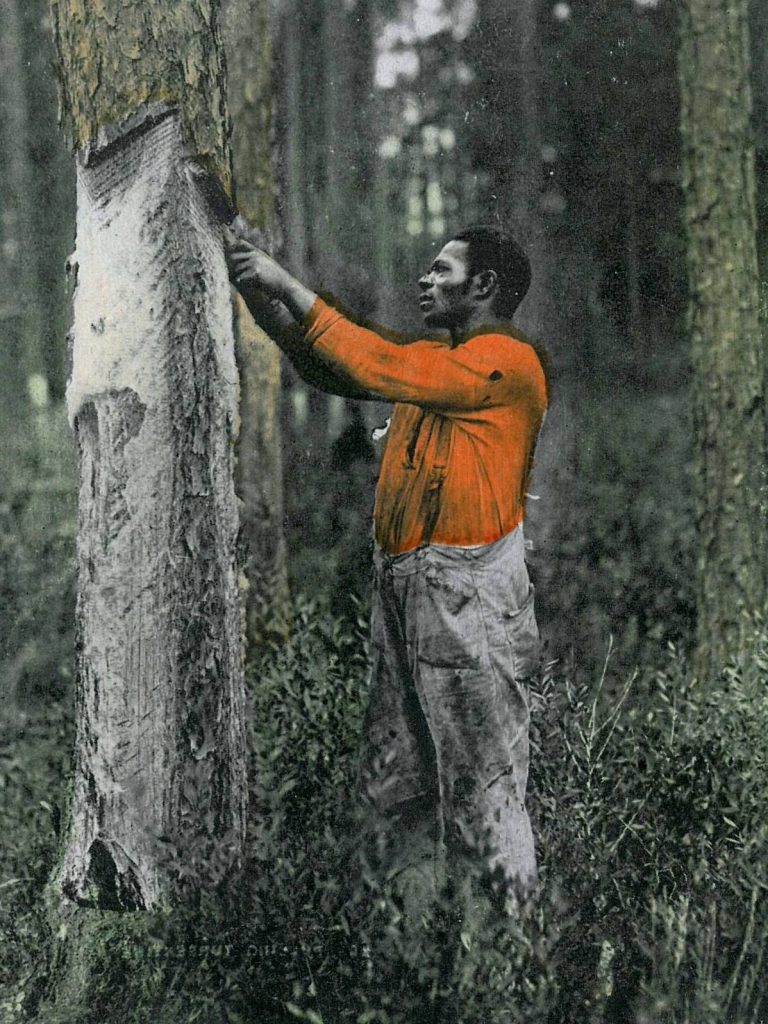
Why? Because certain jobs were so grueling and harsh -- mining, logging, and the manufacture of turpentine -- that employers could rarely amass the workforce they needed without coercion.
Here's how debt peonage worked:
Starting at the turn of the 20th Century, state legislatures across the South enacted "vagrancy" laws. These declared that any unemployed but able-bodied male over eighteen was guilty of vagrancy, punishable by a fine of perhaps twenty dollars. The laws were typically used against Black men under forty, few of whom could pay the fine.
When a new "vagrant" was charged, the operators of a turpentine or logging camp would swiftly pay the fine, transport the new man to their camp, and put him to work to pay off his debt.
Alas, it was a trap. The worker would toil sunrise to sunset for weeks or months, only to discover that his employer was charging him for food, housing, transportation and tools -- and that he was now deeper in debt than the day he arrived. Countless immigrant men newly arrived in northern U.S. cities were likewise tricked into taking jobs down South. Many were never heard from again.
But woe to him who tried to flee such soul-crushing labor. These workplaces were ruled by armed guards and fierce dogs capable of tracking and mauling anyone who attemped escape. A few made it, of course, but most were caught and whipped, or clubbed -- even caged -- as punishment.
Worst of all, their attempted escape was deemed "theft of property" or "breach of contract" under law. Typically a misdememeanor, it imposed impossible fines up to $500 that could keep a man trapped -- enslaved -- for life.
Likening all this to slavery may seem an exaggeration, but no. Prior to the Civil War, owners of slaves paid handsomely for them and had a vested interest in keeping them healthy enough to work and produce offspring. Not so debt slavers. If a man dropped dead from heat exhaustion or infection or a beating, the guards simply buried him and the camp advised the county it needed another hire.
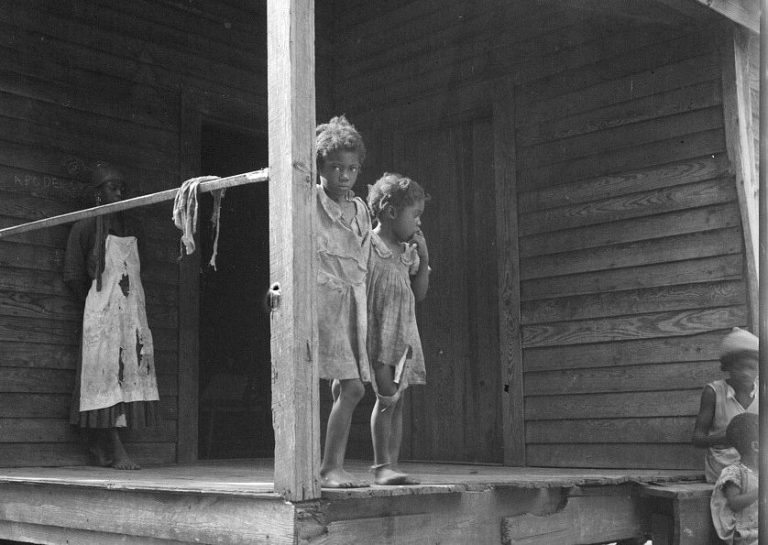
Turpentine camps usually allowed debt prisoners to keep families, making prisoners less likely to escape. To that end, a camp might provide schooling and Sunday church. Some also operated (or tolerated) a "jook joint" where folks could dance, drink, gamble and make music.
The fictional camp Birds Eye, locus of Brother, How Long?, is such a camp.
Debt Peonage
Brother, How Long?
A Novel
By David O'Reilly
Chapter 1
THE LITTLE BLACK STICK WENT THAT WAY, up and down, with a little curve off its right side. He shifted in his seat, then scraped a shoe on the floor, but there was still no sound in his head.
She hesitated. Waiting too long might shame him, but too soon could shame him, too. She studied the gash on his neck that had nearly killed him weeks ago, then touched the two tall sticks with the line in between.
“This one looks different,” she said, and now touched the shape with the curve. “But it makes the same sound as that. Remember? What sound is this?”
As John Way struggled to make sound and sense of these letters, Althea spied the white spaces between the printed lines on the page before them. Showing faint through the paper’s thinness she read detucesrep and snos, examples of a curious thing she had tried to give meaning to years before. As a child those reverse words seemed to belong to a separate world “on the other side of the page - the place words come from, before they become words...” - only she wasn’t sure what she meant. When she tried to explain it to Mama, at twelve, her mother had just studied Althea’s face and nodded. Everybody on Mama’s side could read young. But Althea…
Now, with her Bible, violently twisted and torn though it was, she was teaching reading and writing and, yes, the Word to a grown man. In the silence she became aware again of the perspiration and wood smoke and turpentine smells rising from Little John’s stained overalls and worn cotton jersey. It was the look and smell and curse of all the men of Birds Eye, but she did not pull away. Birds Eye filled her with sadness. Anger, too. Its sons, persecuted.
Then John emitted a breathy “hhh” sound.
“Yes!” she exclaimed, and made a clap of her hands that startled him. “And it starts which word?”
“That one is, uh, `Hallowed?'”
“And this one?”
“Um, `heaven?’
“That's right.” she said. “But see? Both these shapes make the `aitch’ sound. In `Hallowed’ it’s a capital, a big letter, because it starts a special word. But here: in `heaven’ it’s a regular aitch. A small aitch.”
Little John looked back, searching the page for the meaning to her strange words. “S’hard, Miss Althea” he said, briefly bowing his head.
“I know,” she said. “But you’re learning. You’re getting it.”
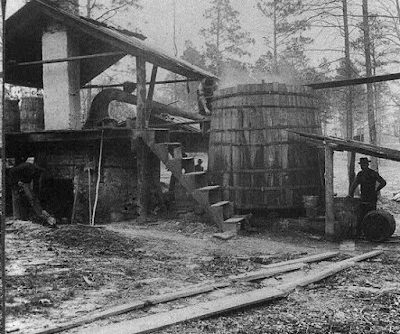
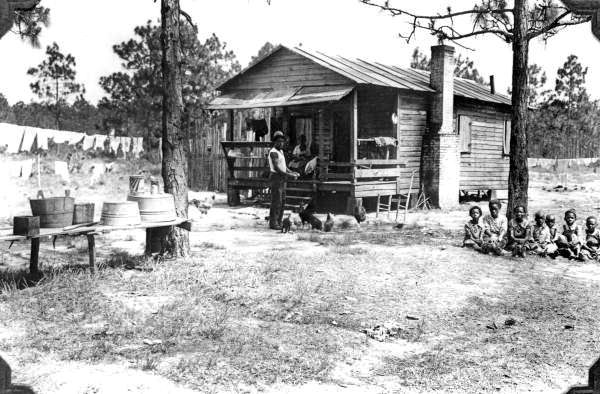
Birds Eye was aught but a turpentine quarter, not even a village. It got its name, so it was said, on account of how the Bible says the good Lord keeps His eye on everybody, including the sparrow, only it didn’t seem like He ever much looked down here. It had a big still with pipes and tanks for cooking pine sap into turpentine, a company store, a schoolhouse, and forty-four shanties not counting those two there that burned down, with some scattered around the perimeter and others so close you could hear your neighbors snore and sneeze and fart and all else their bodies did. Some were made of bark log with a shake roof sagging this way and that. The newer were of board with tar paper on top and sleds on the underside for towing, only they leaned some, too. All were but a room or two or three with a cookstove and a zinc top table at one end, with common privies on the outside.
Most everybody slept on cotton blankets or straw pallets, three and four or more children in some. There were little windows without glass, some with chicken wire to keep out the squirrels and birds. Folks said rattlesnakes could climb up a wall only that was a lie, but it was true you could meet a snake in these parts anytime.
Althea and Little John met Sundays after church, at the school house, and today was their second lesson teaching him to read. At their first Althea had written the alphabet in capitals and lower case, and a prayer in big letters below it. John Way didn’t know a whole lot that was in the Bible, but he pretty much remembered this prayer.
“Each time you look at it,” she told him that first day, “pray one word at a time out loud, and put your finger on it. Like this.” She then laid her finger on the big circle that began the first word.
“Our,” she said.
“Our,” he repeated.
It was springtime six years ago, April or so as he remembered it, that Little John was walking on a dirt road, whittling on a stick and humming about the everlasting arms, when a white man on a horse passed him by. “Why ain’t you workin?’” he demanded to know. John said he didn’t have no job, and the rider man said as how that made him a vagrant, and he was deputized to arrest vagrants. “Y’all don’t look like no deputy,” John said. He should have known better. The rider looked him up and down and spat, then backed his horse around to show him the rifle holster on his saddle. John was made to follow behind three miles to a warehouse in Century, by the Alabama line.
The rider tied up his horse and took John inside. After a time a fat man with a straw hat came in from the back wiping his hands on a rag. The rider man told John to step up, as this was a justice of the peace, only he didn’t wear a robe. Then the judge said boy, you have to pay a fine of twenty dollars “on account of you’se a vagrant.” It was the law in Florida all right, only they didn’t much use it against white boys.
Little John said he didn’t have twenty-five cents, and the white men laughed, and the rider told the judge that Villeroy Naval Stores Co. would pay the fine and this boy could work it off. “Naval stores” being the name for making turpentine in these parts. The judge just nodded. He’d done this at least fifty times, maybe a hundred. John said nothing.
Then the judge asked John what was in his pocket. John showed him his whittling knife and the judge said he must have stolen it, and upped the fine to thirty dollars. John got angry, said it was his from his daddy, but the judge said “Be quiet boy. You carryin’ a weapon. I’ll put you on the gang,” and John just hung his head. “You got the right idea,” said the judge. “Best you make no trouble,” and he sentenced John to working seven months in turpentine to pay off his fine. Took his knife, too. Put it right in his own pocket. Six years later John was still trapped in debt to Birds Eye.
After a long time praying for deliverance John had come to despair of church and Jesus and all hope. He wasn’t stupid except when he got liquored, which he did from time to time. Last time was March, when he got into a card game called ‘skin’ with two boys passing through. Up on the hill they made a campfire. After a time and some laughs and John losing money he saw they were cheating him, only now he was drunk, so he up and socked the closer man on his ear, only the man was big as John was small. Might have just knocked John down with a fist and walked away. Instead he pulled a three-sided hack file out of his shirt and stuck John between the neck and collarbone. Punctured his lung. John fell down and they were gone, and when Rupert found him he was still as a log, blood bubbles coming out of his neck.
Rupert fetched a barrow and took him home. John’s woman, Eula, was all shrieking and praying, sure John would die in front of their girls, only Rupert ran up the hill and got him a medicine from Miss Mary. Eula made a plaster, patched his neck and made a tea of it. John had a mumbling fever for three days before it broke, only his right arm was sore and weak for a long time after. Promised Jesus he would give up gambling and drinking if the Lord would free him from turpentine.
Four weeks later Miss Althea Walker showed up, riding part way in on a mule cart. She was dark skinned, finely dressed, taller than most men. She was seventeen.
How My Novel Took On A Life of Its Own
"Write what you know" is the age-old advice for fiction writers. But as I embarked on the novel that would become Brother, How Long?, I decided to challenge myself.
I would create young, working-class characters with little power, education, or opportunity for self-expression, but who would grow despite their circumstances. And so I began by creating Danny Gallagher: a twenty-two year-old rookie cop in Philadelphia. It's just after World War II, and he's furious at all the Blacks moving into his Irish Catholic neighborhood.
But when Danny befriends Althea Walker, a young Black woman newly arrived from the South, I got to wondering: what's her background? Where did she come from? So I started to imagine a back story for Althea that I supposed might fill one chapter. Then, as I researched various possibilities, I discovered the astonishing history of legalized debt slavery that had trapped thousands of Southern Black men -- immigrants, too -- in soul-crushing labor in the late 19th and early 20th centuries.
Well, guess what? I ended up ditching Danny and Philadelphia for Althea -- she's tall, dark-skinned, exceptionally bright -- and sending her on an astonishing journey into a brutal Florida turpentine prison camp. And when I say "astonishing," I mean I was astonished by her journey. She and the story took on lives of their own, unfolding in ways I never expected. Seven dead bodies, a ghost, a cryptic prophecy and much more would appear as I tapped away, each delivering their own surprises.
--David O'Reilly
My Working Cover
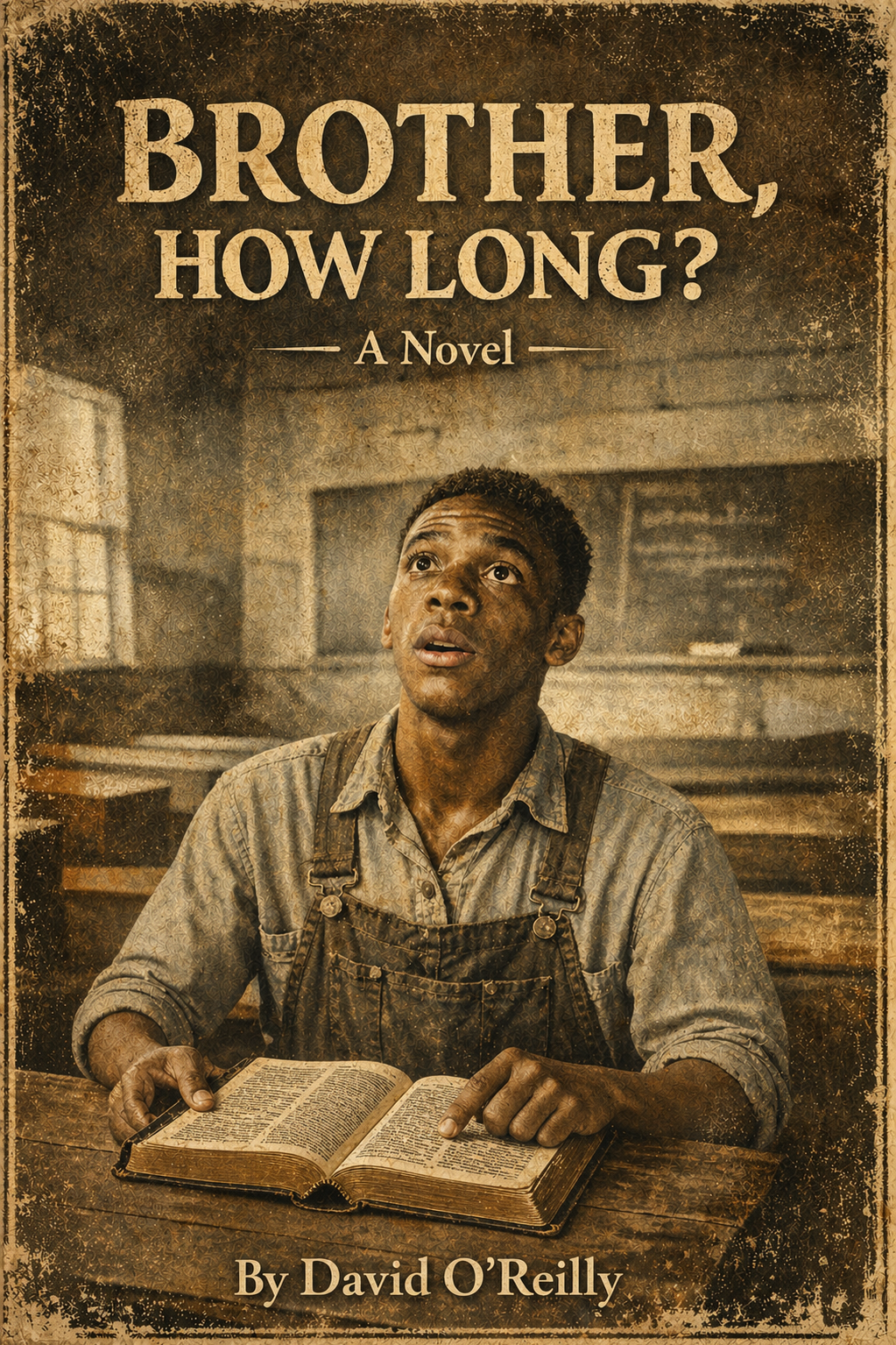
The cover is based on the opening scene of the novel. John Way, one of the turpentine workers held captive in debt peonage, is learning to read using a Bible. He's just grasped a written word for the very first time.
A few weeks after I'd finished the manuscript for Brother, How Long? I passed it on to a former reader, now an imprint manager, at Macmillan Publishers. She pronounced it "very well written" and "worthy of publication." But because I'm a white male, and my main character is young, Black and female, she suggested I have the MS read by a sensitivity reader before I seek a publisher.
Sensitivity readers, I discovered, advise authors and other creative types who are depicting people unlike themselves. So a straight person writing about LGBQT characters, or an able-bodied author with a main character in a wheelchair, might want to have a person of that "otherness" take a look.
Several of my friends -- one a best-selling author -- felt this smacked of censorship. But I learned that a good sensitivity reader doesn't censor a book or insist that an unsavory minority character be expunged or made "nice." Instead they advise on whether the characters, story line and sense of place feel authentic.
Well, I liked the sound of that, but soon found that anybody can hang out a shingle claiming to be a sensitivity reader -- and the author has no easy way of determining whether they have the requisite skills.
Nevertheless, I queried several I found online -- including one who looked superb -- but they did not reply. Then I found one who said yes, but when I saw some things she'd written online she didn't seem a skillful writer. And a friend of a woman who advises museums on sensitivity wanted to charge $65 an hour to read my 95,000-wordmanuscript. The proposed fee was thousands more than I was prepared to spend. What to do? As I debated, I got an offer from Atmosphere Press to publish my book.
I told Atmosphere's acquisitions editor about my concerns. She said they didn't have sensitivity readers as such, but that my development editor would read the manuscript with an eye towards authenticity and respect.
And so this raises some interesting questions: Is it all right for me to proceed without review by an African-American (ideally female) sensitivity reader? Does a novelist have the right to create characters who are "other" than themselves? If so, how strict might the limitations be?
Can a female author have male characters? Certainly. Can an emotionally healthy novelist (if such people exist!) write about depressed or mentally ill characters? I'd say yes, but authenticity and respect here might be elusive -- especially if the author starts to confect bizarre mental landscapes to entertain the reader.
So, I'm interested in reader feedback. Does my character, Althea, feel authentic? Do the other Black characters? Do my rich and powerful white characters? Some of them are mighty ugly.
I'm clearly ahead of myself here. Brother How Long? won't be published until August. But I believe the opening chapter, posted above, conveys the tenor of the writing. So I'd like to start a conversation now and get your feedback. Do my characters feel real? Does the hinted-at story line engage you?
DOR
Fiction, Fairness, "Otherness"
Contact me
E-mail: david@davidcoreilly.com
Address: Pennsylvania, United States